


What this service is for
What this service is for
Academic copyediting focuses on the finer details of your writing, ensuring clarity, precision, and consistency throughout. It strengthens your language, improves the flow of your ideas, and ensures your work meets academic standards—without changing your meaning or voice.
Whether you’re preparing a journal article, dissertation, or research report, copyediting helps you present your ideas with confidence and credibility.
Ideal for

Ideal for

Journal articles


Theses
&
Dissertations

Journal articles
Theses & Dissertations
Conference papers
Literature reviews
Research proposals
Conference papers
Non-native English speakers
What this service is for
Literature reviews
Non-native English
speakers
Research proposals
The Editorial Process
Send your thesis, dissertation, article, or paper.
01

Submit Your Work
Style guides, journal instructions, and supervisor notes are checked.
02

Requirements Review
A careful first read captures your voice, tone, and overall direction.
03

Initial Read-Through
The rhythm, logic, and progression are assessed.
04
Structure & Flow
Grammar, punctuation, phrasing & tone are refined.
05

Sentence-Level Copyedit
Margin notes explain issues and highlight items to clarify.
06

Clarity Comments
Terminology, register, formatting & style are standardised.
07
Consistency Check
A final pass ensures accuracy, polish & smooth reading.
08

Final Quality Review
You receive the promised documents via email.
09

Delivery Suite
Questions are welcome, and a follow-up discussion can be arranged if needed.
10

Follow-Up Support

What’s Included
What’s Included
Grammar & Syntax

Correcting grammatical errors & refining sentence construction for polished prose.
Spelling & Punctuation
Correcting spelling, punctuation & typographical errors throughout the document.
Clarity & Readability
Reshaping awkward, unclear, or overly complicated sentences.
Conciseness
Removing repetition, wordiness & redundant phrasing without stripping away nuance.
Academic Tone & Register
Refining informal, imprecise, or awkward language while preserving scholarly voice.
Sentence Flow & Rhythm
Improving the movement between clauses & sentences so the prose reads naturally.
Transitions & Cohesion
Strengthening connections between sentences and paragraphs.
Terminology & Word Choice
Ensuring that terminology is precise, appropriate to the context & used consistently.
Internal Consistency
Standardising recurring elements, including capitalisation, hyphenation & abbreviations.
Ambiguity & Unclear Meaning
Identifying wording that could be interpreted in multiple ways & refining it for clarity.
Authorial Voice Preservation
Improving the language without flattening the author’s individual academic voice.
Editorial Queries & Comments
Flagging passages that require the author’s input.
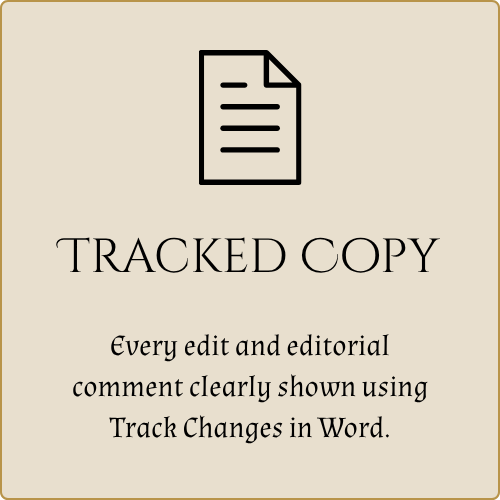
What you receive
What you receive
FAQs
FAQs
-
No — proofreading is the final error check. Copyediting focuses on clarity, grammar, tone, and readability.
-
Yes, technical terminology is not a problem. The language mechanics remain universal.
-
Absolutely — APA, MLA, Chicago, Harvard, Oxford, journal-specific styles, and institutional requirements.
-
Yes — in fact, this is one of the most common uses of academic copyediting.
-
I work comfortably in both UK and US English. Just let me know your preference (or your institution’s requirement), and I’ll apply it consistently throughout your document.
-
Yes. Many universities and research organisations prefer direct invoicing, and I can bill your institution if needed. If your department requires a cost centre, project number, or specific invoicing details, simply include them when you book the service.
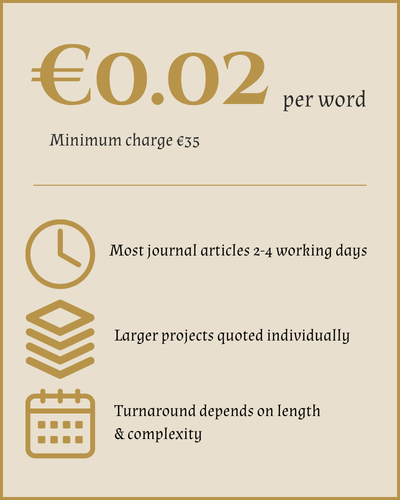
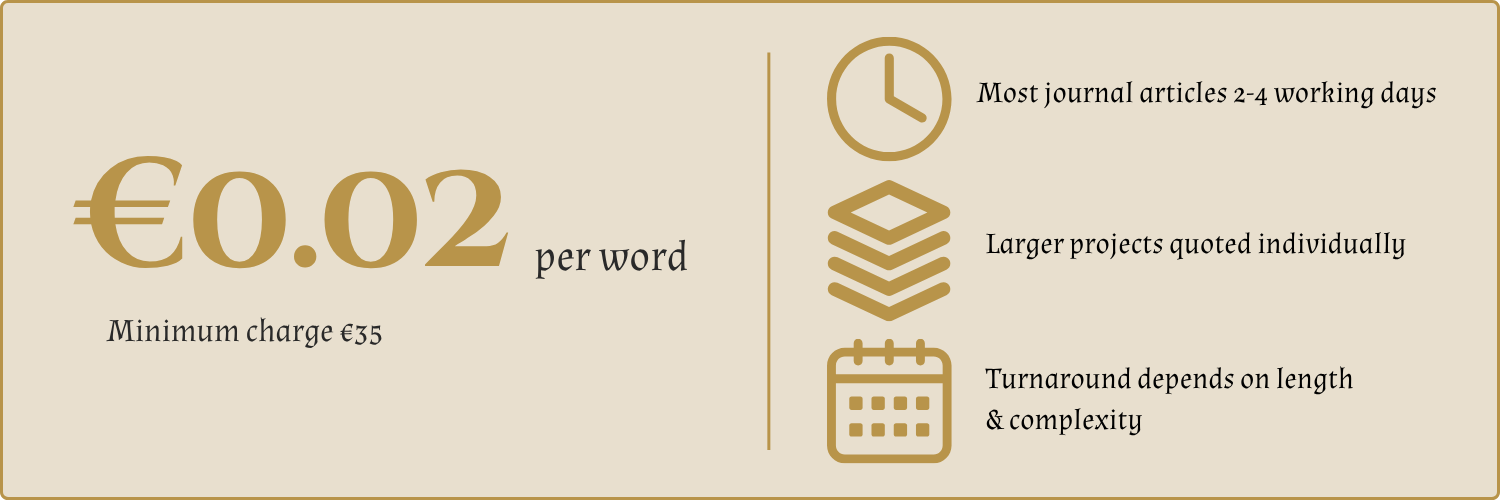
Price & Turnaround
Price & Turnaround


Ready to Strengthen Your Writing?
Get a tailored quote for your academic copyediting project.